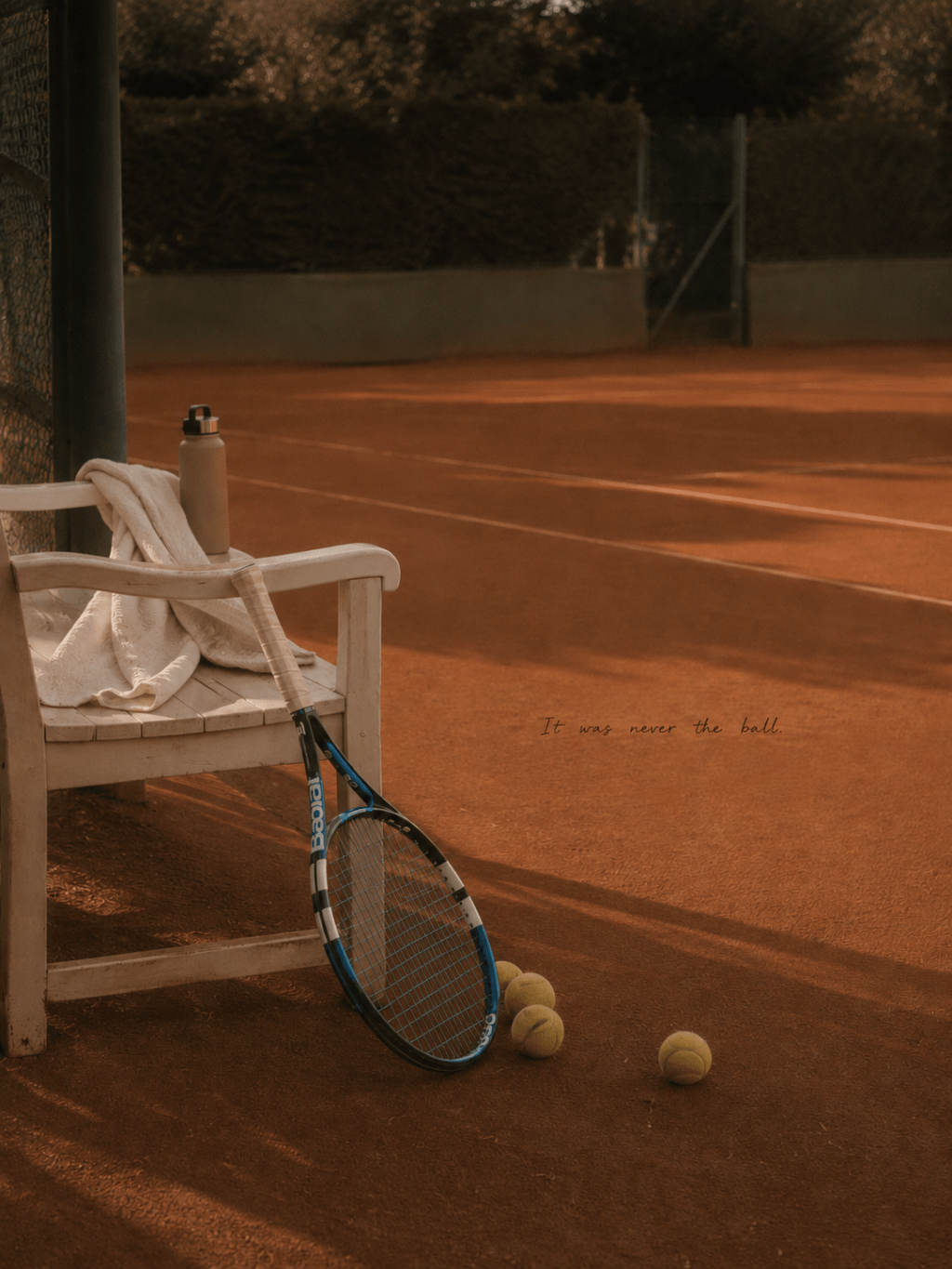
If you happened to read The Return of My Terrible Footwork a while ago, you may remember that I finished by confidently announcing I was going to take tennis lessons again.
To the surprise of absolutely nobody except myself, I actually did.
Three lessons to start with, to be precise.
I’d forgotten how peculiar it is to return to something you once spent years doing. Twenty years is apparently a very inconvenient amount of time. It’s too long for everything to feel familiar, yet nowhere near long enough to blame complete ignorance.
Somewhere underneath the rust, the technique is still there, quietly waiting to be rediscovered, which sounds encouraging until someone points it out to you.
My coach did exactly that: “You’ve still got the technique.”
It wasn’t the answer I’d secretly been hoping for.
I’d secretly been hoping she’d tell me I’d forgotten everything, because that would have been wonderfully straightforward.
If you’ve forgotten something, the solution is obvious: practise. Repeat. Be patient. Eventually it comes back.
But if the technique is still there, then you’re left with a rather less satisfying explanation.
Maybe it isn’t my forehand that’s causing the problems.
Maybe it’s me.
She keeps telling me that my body knows what to do, and every now and then I catch a glimpse of the player I used to be. I’ll hit one forehand that feels effortless, hear that familiar sound as the ball leaves the strings and lands exactly where I wanted it, and for a split second I’ll think, There you are. I wondered where you’d gone.
The trouble is that she never stays for very long.
The next ball arrives, usually one of those lovely slow ones that everyone insists are easier. They aren’t, at least not for me. They simply stay in the air long enough for me to become fascinated by things that were perfectly fine a moment earlier. Suddenly I’m analysing my footwork, reconsidering my grip, questioning where I’m standing and mentally rewriting the entire forehand before I’ve even hit it. By the time I’ve finished improving a shot that didn’t actually need improving, the rally has quietly moved on without me.
Fast balls don’t seem to have this effect on me.
They don’t give me enough time to interfere.
They arrive, I react and, surprisingly often, I hit them rather well. My body simply gets on with its job before I’ve had the chance to organise an entirely unnecessary strategy meeting with myself.
The slow ones are different, the slow ones are dangerous.
Not because they’re technically more difficult, but because they travel through the air with just enough patience to allow me to get in my own way.
My actual coach is remarkably calm. She smiles, feeds me another ball and occasionally reminds me to trust what I’ve spent years learning. It’s perfectly sensible advice, although I’ve discovered that “trust yourself” belongs in the same category as “just relax”. They’re lovely ideas in theory, but considerably less useful the moment someone says them out loud.
The only thing that consistently improves my tennis is talking about absolutely anything except tennis.
We’ll end up discussing work, holidays, coffee, supermarket queues or whether motorway service stations have ever made anyone genuinely happy, and somewhere in the middle of that conversation I’ll suddenly hit three excellent forehands in a row. Apparently I’m perfectly capable of playing tennis, provided I’m distracted by something completely unrelated.
I even caught myself wishing someone could attach invisible strings to my shoulders, elbows and wrists and simply move me through the perfect forehand a few hundred times while I stood there doing nothing more mentally demanding than deciding what to have for dinner. It sounds ridiculous, but I wasn’t looking for somebody to play the shot for me. I just wanted to know what it was supposed to feel like without my own thoughts constantly interrupting.
When i was visiting family in Maastricht, my brother-in-law suggested we should have a match.
Before we walked onto the court we were laughing about the fact that I’d played quite a decent level years ago. There was the usual family optimism, a few jokes about whether I’d still have it and a general agreement that this would probably be entertaining regardless of the outcome.
They weren’t wrong.
For long stretches I actually played much better than I’d expected. The timing occasionally came back, my serve still had more pace than I thought it would and every now and then I recognised flashes of the player I remembered being.
Unfortunately those moments had an annoying habit of disappearing the instant I noticed them, as though confidence itself was enough to persuade me to start interfering again.
The match finished 6–4, 7–5.
Close enough to leave me encouraged.
Far enough away to remind me that three lessons do not undo twenty years.
Oddly enough, the most interesting part of the afternoon didn’t happen on the tennis court.
It happened on the drive home.
We were talking about the match when my brother-in-law said, almost in passing, that he actually preferred it when I served harder. I looked at him: “Really?”
“Yes,” he said. “When you hit it hard, I don’t have time to think.”
That sentence stayed with me for the rest of the journey home.
Because I realised I had exactly the same problem (only way worse). It had never really been about difficult balls.
It had been about slow ones.
Not because they asked more of my tennis, but because they gave me just enough time to overcomplicate something my body already knew how to do.
I’ve thought about that conversation surprisingly often since then, partly because I keep discovering that tennis isn’t the only place where slow balls exist. They’re hiding in emails that don’t need another rewrite, conversations that would probably go better if I stopped rehearsing them in advance and all those ordinary moments where another five minutes of thinking somehow feels as though it must produce a better answer than the one I already have.
The next slow ball will probably arrive in a few days and I’ll almost certainly overthink it. At least now I’ll know why.
It was never the ball.
-Sophie Quinn





Leave a Reply