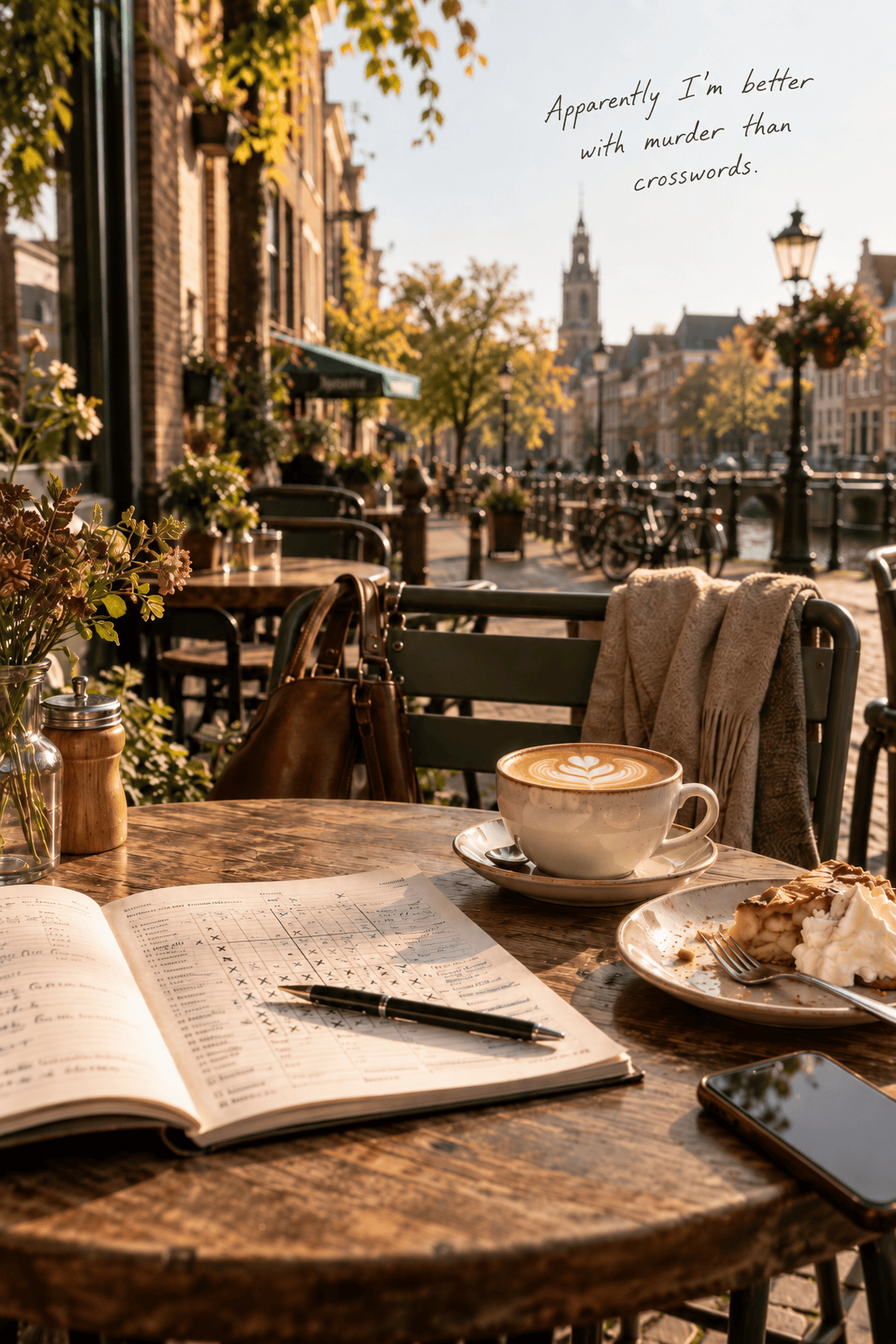
I like puzzles, although I should clarify immediately that this does not include jigsaw puzzles. I have never understood the pleasure of spending several hours looking for a tiny piece of blue sky so that eventually you can recreate a picture that was already perfectly visible on the box.
I mean puzzles that require you to work something out. Give me clues, suspects, contradictory statements and preferably a murder, and I’m happy.
I think this started years ago with my Nintendo DS, which is what the little Nintendo device that folded shut was called, something I’d somehow completely forgotten until recently. I had detective games on it where you had to solve riddles to move through the story, and I loved them, even when I spent an unreasonable amount of time staring at the screen completely unable to see something that became painfully obvious the second I finally found the answer.
These days I’ve moved on to Murdles and Murdoku, which I usually describe as what might happen if Sudoku and Cluedo had a slightly murderous child. You get a collection of clues and have to work out who was in which room and, eventually, who the murderer must have been.
On a good day, I feel extraordinarily intelligent.
I’ll sit somewhere with a latte, preferably something to eat and the sun on my face, and suddenly everything clicks. One clue eliminates somebody from one room, which means someone else must have been somewhere else, and before long the whole thing starts falling into place. If I’m really on form, I can solve three of them in an hour and spend the rest of the afternoon feeling as though I should probably be contacted by the police whenever they have a particularly difficult case.
I cannot overstate how clever I feel at these moments.
Unfortunately, Murdoku is also very good at reminding me that this feeling should not be trusted.
There are other days when I can stare at exactly the same type of puzzle for forty minutes and understand absolutely nothing.
The clues are written in a language I understand, the rules haven’t changed and I know there must be a logical next step somewhere on the page, but my brain has apparently closed for maintenance.
I’ve learned to put the book away when that happens. Sometimes I come back later and immediately see the connection I missed, which is satisfying but also slightly annoying because the information was clearly available to me the entire time.
I should probably mention that I don’t have particularly strong moral objections to cheating in games if cheating helps me win. If a game has hints, solutions or cheat codes, I’ve always considered them resources rather than an ethical dilemma. I played The Sims in the era of rosebud and klapaucius, when a few strategically typed words could make you ridiculously rich, and I certainly wasn’t going to make my Sims live in a modest starter home merely because earning money honestly would build character.
With Murdoku, however, I’ve become much stricter with myself. I don’t look at the answers anymore, even when I’m completely stuck, which means that when I finally solve one I get to experience the genuine satisfaction of knowing I did it myself rather than the somewhat less impressive satisfaction of having successfully located the solutions page.
My enthusiasm for puzzles is oddly specific, though. A friend recently told me he loves crosswords, including the Swedish kind, and I realised once again that these do absolutely nothing for me. You would think somebody who spends a considerable amount of time writing would be reasonably good at puzzles involving words, but apparently my vocabulary becomes unavailable the moment somebody puts little squares around it.
Give me a clue like “another word for enthusiastic, seven letters” and I can almost physically feel every word I’ve ever known leaving my body.
Ask me which fictional dinner guest couldn’t possibly have been in the library at 8:15 because she was seen near the conservatory with a candlestick, however, and suddenly I’m Scotland Yard.
I also like actual games, particularly when my brothers come over for dinner. We often end up playing Mens erger je niet, essentially the Dutch version of Ludo, a game whose name translates rather beautifully as Don’t get annoyed, despite the fact that its entire purpose appears to be making members of your own family hate you.
I almost always lose, which is particularly unfortunate because I really like winning. I can be doing brilliantly, become just confident enough to think that perhaps this is finally my evening, and within ten minutes every piece I own has been sent back to the beginning and one of my brothers is looking far too pleased with himself.
My competitive nature has also become something of a professional issue.
We occasionally play games with the staff at work, which should theoretically be a cheerful team-building activity between colleagues. Unfortunately, I am both the school director and someone who apparently considers a casual quiz an appropriate environment in which to demonstrate a will to win.
The solution has been elegant.
I now help organise the games.
This means I already know the answers and therefore can’t participate, which I choose to interpret as recognition of my organisational abilities rather than a workplace intervention.
So today, on a beautiful Sunday when October has unexpectedly given us nineteen degrees and sunshine, I’ll probably take my Murdoku book somewhere, order a latte and something nice to go with it, and solve a few imaginary crimes.
Every now and then I still wonder what people think when they see me sitting alone in a café or on a terrace with my puzzle book. Perhaps they don’t think anything at all, which is probably the more realistic answer. Either way, the alternative is spending the same hour scrolling through Instagram or looking at clothes I absolutely do not need, so sitting in the sun trying to establish who murdered an imaginary person in the library seems like a perfectly respectable way to spend a Sunday.
Besides, I like it.
And if today’s puzzles go well, I’ll spend at least twenty minutes believing I’m exceptionally intelligent; if they don’t, there’s always next Sunday.
Just don’t give me a crossword.
-Sophie Quinn






Leave a Reply